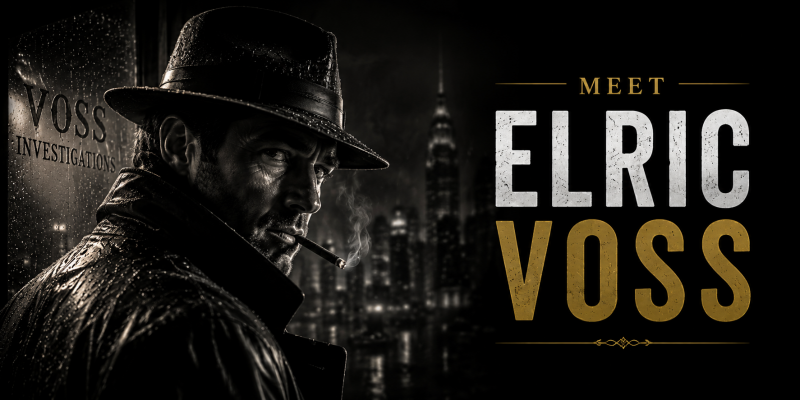
Enter the World of Elric Voss, if you feel brave...

Elric Voss drinks his coffee scorched because walking three blocks for a better cup means answering questions he can’t afford to answer. He keeps a desk drawer that’s stuck at three-quarter open, hinge bent since a client’s husband tried to put his head through it, but he never fixed it because some scars are worth keeping around as a reminder of what carelessness costs. His knee complains in weather that can’t make up its mind. He reads the same case file forty times waiting for it to say something new, because he already knows files lie the same smooth way people do.
Then there are the mornings a stray drift of cigar smoke puts him back in a hallway that hasn’t existed in nine years, standing in front of a father who could lie to his mother without breaking stride, before Elric catches himself, realizes the smoke is only his own cigarette from the night before, and has to talk himself back into the room.
That’s the shape of him: a man who notices too much, forgives too little, and keeps working anyway. In Deadly Truth, that habit of noticing is what gets him hurt, and what won’t let him stop.
A Day in the Life of Elric Voss


The coffee maker in my office had one setting: scorched. I drank it anyway, because the alternative was walking three blocks to a diner where the waitress asked too many questions about my black eye, and I didn’t have an answer that wouldn’t get her killed for knowing it.
Six-forty in the morning and Newark hadn’t decided yet whether it wanted to rain. The sky sat the color of an old bruise, yellow at the edges where it hadn’t quite healed. I liked mornings like that. Nobody trusted them enough to lie to you yet.
My desk drawer stuck at the same three-quarter mark it always did, and I fought it the way I fought most things in my life, badly, and with my whole body. The bottom hinge had been bent since a client’s husband tried to put my head through it two winters back. I never fixed it. Some scars you keep around to remind you what carelessness costs.
The Petrova file sat where I’d left it, corners curled from too many nights under my thumb. Missing husband, six weeks gone, wife paying in cash that smelled like it had been kept somewhere damp. I flipped it open and read the same three sentences I’d read forty times, waiting for them to say something different. They never did. Files were like confessions that way. You could read them a hundred times and they’d only ever tell you what the liar wanted you to hear the first time.
The knock came at eight, hard enough to rattle the pebbled glass.
“It’s open,” I said, not looking up.
The man who came in wore a suit that cost more than my rent and carried himself like he’d never once had to wait for anything in his life. Dale Correy. Ran the numbers for a shipping outfit down on the piers, or so the sign on his office door claimed. I’d met three men with that same haircut and that same handshake, and all three of them had turned out to be lying about something.
“Mr. Voss.” He didn’t sit. “I need something found.”
“Everybody does.” I closed the Petrova file, slow, the way you close a door on a room you don’t want somebody looking into. “Sit down or don’t. Makes no difference to the rate.”
He sat. Told me about a ledger gone missing from a locked cabinet, about a partner he trusted the way you trust a dog that’s already bitten you twice. I wrote nothing down. I never wrote anything down in front of a client. Let them wonder what stuck and what didn’t.
Halfway through his story, a smell drifted in under the door. Cigar smoke, sweet and rotten at once, the kind that clung to velvet curtains and old men’s coats.
I knew that smell. It belonged to my father, dead nine years, buried in a suit he’d never once worn while breathing. For one full second I was eleven years old again, standing in a hallway that didn’t exist anymore, listening to him tell my mother a lie so smooth it should’ve been illegal.
Then Correy shifted in his chair, and I saw the stub burning in the ashtray on my own desk, left over from the night before, from me, not from a ghost. The past had a way of showing up in the smallest things and then admitting, a beat too late, that it was never really there at all.
“Mr. Voss?”
“I’m listening.” I wasn’t, not entirely. Some part of me was still standing in that hallway. “Tell me about the partner.”
By noon I’d taken his retainer and lost an hour I wouldn’t get back. By three I’d walked the docks twice, my knee complaining on every third step like it did in weather that couldn’t make up its mind. By six I’d learned two true things and one lie, and I couldn’t yet say which was which.
I locked the office at eight, the bent hinge groaning behind me, and stood a moment on the landing while the rain finally came down and made its decision for the sky. Down on the street, a cat picked its way along the gutter, careful, the way anything smart in this city learned to be.
I watched it disappear into an alley I knew for a fact went nowhere.
An Evening with Selene Polari


Rain had been falling since four, and by seven it had stopped pretending to be gentle about it. Selene Polari watched it streak the shop window in ropes, distorting the gold lettering on the glass until POLARI RARE BOOKS looked, backward and dripping, like a word in a language nobody living still spoke.
She liked closing the shop this way, alone, the bell over the door silent for the first time all day. The smell of old paper settled into the room the way a cellar breathes when you open it after a long winter, dust and leather, and a sweetness underneath that reminded her, always, of her grandmother’s hands. She didn’t examine that thought further. Some doors she kept shut on principle.
The ledger needed balancing. It never balanced, not on the first pass, and she’d stopped expecting it to. Numbers lied the way people did: smoothly, and only when it mattered.
A man came in at seven-fifteen, shaking rain from a coat that had clearly never been cheap and clearly hadn’t been maintained either. Warren Ashby. She knew him the way she knew most of her regulars, by the books he asked for and the ones he pretended not to want.
“You’re closed,” she said, not moving to lock the door.
“You’re still standing there.”
“Observant.” She set down her pen. “What do you need, Mr. Ashby, that couldn’t wait for daylight?”
He didn’t answer the question. He asked instead whether she’d heard anything about a private investigator working the harbor cases, and something in the careful way he said it told her the question mattered more than the books ever had.
“I hear a great many things,” she said. “Most of them are wrong.”
“But not all.”
“No.” She let that sit a moment, the way you let a good wine breathe before deciding whether it deserved swallowing. “Not all.”
Ashby’s fingers drummed the counter, three beats, always three, a habit she’d catalogued the way she catalogued everything about the people who walked through her door. He wanted something from her that wasn’t a book, and she watched him circle it the way a man circles a debt he can’t pay outright.
“Elric Voss,” he said finally. “You know him.”
“I know a great many people.” She smiled, thin and unhurried. “Knowing someone and vouching for someone are different transactions, Mr. Ashby, and I don’t extend credit on the second.”
For a moment she thought she heard footsteps on the stairwell behind the back office, someone climbing slow and careless, and her pulse went sharp before she remembered the building was empty, had been empty since six, and the sound was only the radiator ticking as it cooled. She stood still until she’d counted the ticks back down to nothing, the way she’d taught herself to do since a year when quiet buildings had given her good reason not to trust them. She never entirely broke the habit.
“That’s catastrophic,” she murmured, mostly to herself, and Ashby had the decency to look uncertain whether she meant him or something else entirely.
She did not tell him what she meant. She rarely did.
He left without buying anything, the bell above the door finally breaking its silence, one thin note swallowed fast by the rain. Selene watched him cross the street through the warped gold lettering, his shape bending and doubling in the wet glass until he looked, for just a moment, like two men walking instead of one.
She turned the lock herself this time. Behind her, the shop settled into its evening quiet, books stacked floor to ceiling like witnesses who had already testified and were simply waiting, patient as paper, to be asked again.
