People expect a private eye to pick locks and punch his way to the truth. The ones who last spend most of their time in parked cars, county records offices, and the good graces of cops who owe them nothing. These are notes on how the work is actually done, and why I do it the way I do.
~ Elric Voss, Private Investigator
In these case files, Mike Wessels takes one piece of Elric’s job at a time, from lifting a fingerprint to buying a detective a cup of coffee for a favor, and shows how it works outside the pages. Every article is true to the trade and tied to a moment from the books.
Elric has more to tell about the work that never makes it into the movies, and new case files are added here regularly. Sign up for the newsletter so the next one finds you first.
Dust, Tape, and Patience
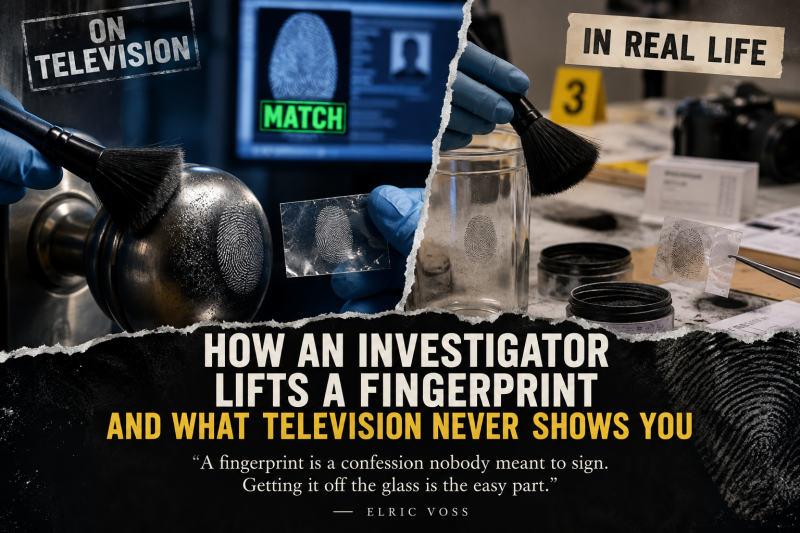
How an investigator lifts a fingerprint, and what television never shows you
A fingerprint is a confession nobody meant to sign. Getting it off the glass is the easy part.
~ Elric Voss
On television, a detective brushes black powder across a doorknob, presses down a strip of tape, and has a name on a screen before the next scene. The real process takes longer and depends heavily on what was touched. It also ends in uncertainty far more often than viewers would guess.
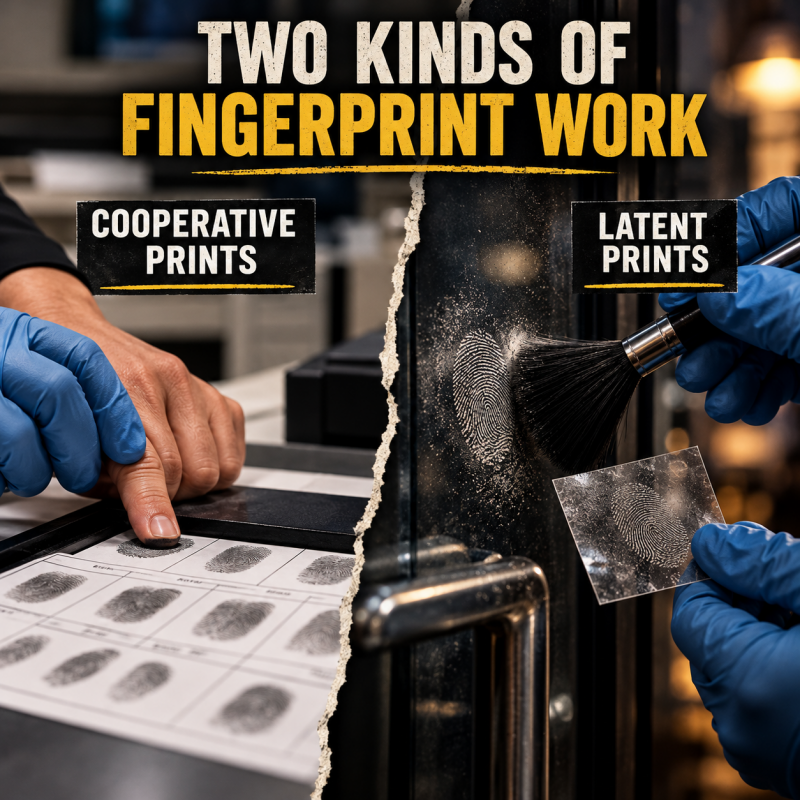
Two Kinds of Fingerprint Work
Private investigators deal with fingerprints in two very different ways. The first is routine: recording a cooperative person’s prints for a background check, a job application, or a client’s own records. These are called tenprints, with each finger rolled from one edge of the nail to the other onto a card or a glass scanner, followed by a flat impression of the fingers pressed down together to confirm the set.
The second kind is what readers picture: finding and lifting prints someone left behind without meaning to. In an active criminal case, that job belongs to police and crime lab staff. A private investigator is more likely to process prints on a client’s private property, such as an office where cash keeps disappearing, or to examine how police handled the prints when a defense attorney hires him to look for mistakes.
Step 1: Know What You’re Looking For
Investigators sort prints into three types. Patent prints are visible, left by fingers coated in blood, grease, paint, or ink. Plastic prints are pressed into something soft, like candle wax, butter, or a bar of soap, leaving a three-dimensional impression. Latent prints are the most common and the hardest to find. They are invisible deposits of skin oil and sweat that copy the ridges of the finger onto whatever it touched.
Step 2: Search With a Plan
The search usually happens in two passes. The first uses a flashlight to catch the visible prints. The second is a blind search for latents, and nobody dusts an entire house. Investigators focus on where a person entered and left, and on anything that looks disturbed: a drawer left open, a lamp on its side, an object that could have been used as a weapon.
Step 3: Match the Method to the Surface
Smooth, nonporous surfaces like glass, metal, plastic, and finished wood take powder. The powder clings to the oily residue, and its color is chosen to contrast with the surface, so a black countertop gets white or gray powder. To avoid smearing a fragile print with bristles, some investigators use magnetic powder, which is spread across the surface with a magnet instead of a brush.
Another option is superglue. Heated cyanoacrylate gives off a vapor that bonds to the print residue and hardens it in place. Labs do this in a sealed chamber, but a handheld wand lets investigators fume a print at the scene before the object is shipped. Too much exposure distorts the print and ruins it.
Porous surfaces like paper, cardboard, and unfinished wood soak up powder, so investigators turn to chemicals. Ninhydrin reacts with the residue and turns a print bluish, but the reaction can take hours unless the item is gently warmed. Iodine vapor produces a brown print that fades so quickly it must be photographed almost immediately. Silver nitrate reacts with the salt in sweat and darkens under ultraviolet light, which makes it useful on cardboard.
Step 4: Photograph Before Touching
Every print is photographed where it sits before anyone tries to lift it. The photo records its location and orientation, and it protects against later claims that the evidence was tampered with. For patent and plastic prints, the photograph may be the only usable record of the print.
Step 5: Lift and Label
A lift uses clear adhesive tape laid over the developed print. The investigator smooths it down, often with the edge of a ruler, to push out bubbles and ripples that would distort the ridges. The tape is peeled away in one motion, covered with a protective backing, and labeled with exactly where the print was found. The lift is then scanned so the image can be enhanced.
Step 6: Compare
A lifted print is only a pattern until someone compares it. Examiners use a method called ACE-V: analysis, comparison, evaluation, and verification by a second examiner. To identify a stranger, the print goes into an automated fingerprint system, usually starting with a local database, then moving to the state system, then the FBI. The computer doesn’t name a suspect. It returns a list of possible candidates, and a human examiner does the final comparison by eye.
What Most People Never Hear
A brush can carry evidence from one place to another. A reused powder brush can transfer trace DNA between rooms or even between crime scenes. Defense attorneys ask whether the brush was disposable.
Prints on skin have the shortest life. Lifting a print from a human body is rare, because the oils absorb into the skin and blur. After about two hours, little is usable.
An unmatched print stays in the database. If no match turns up, the print remains on file. Years later, the person who left it might get fingerprinted for a government job, a gun permit, or an adoption, and the old print suddenly has a name.
Identical twins don’t share fingerprints. Their DNA matches, but their ridge patterns don’t.
One case can mean thousands of comparisons. A scene with 100 latent prints and eight possible subjects, each with ten fingers, can require up to 8,000 separate comparisons.
Sometimes the answer is “maybe.” Examiners describe the hardest results as prints too similar to rule a person out, yet not clear enough to call a match.
The examiner usually isn’t a detective. Many latent print examiners receive the prints with few details about the case, and they say the work is quiet and tedious, nothing like television.
Why Elric Can’t Do It Alone
All of this explains a choice Elric makes again and again. A private investigator can dust and lift a print, but he can’t run it through the law enforcement databases that turn a stranger into a name. A print he handles carelessly can also become an argument for the other side in court.
So Elric doesn’t walk away from a scene with a name in his pocket. He walks away with a strip of tape and a favor to ask.
Next case file: why a PI’s best tool is a cop who owes him one.
References
Herald Scholarly Open Access. (n.d.). Finger printing. Journal of Forensic Legal & Investigative Sciences. https://www.heraldopenaccess.us/journals/journal-of-forensic-legal-investigative-sciences/highlights/finger-printing
Sheridan, S. (2013, June 20). Techniques for collecting and analyzing fingerprints. Forensic Resources. https://forensicresources.org/2013/techniques-for-collecting-and-analyzing-fingerprints/
Upton, K. (2026, October 1). What does a forensic fingerprint expert do? All Criminal Justice Schools. https://www.allcriminaljusticeschools.com/specialties/forensic-fingerprint-experts/