The Long Watch
How a private investigator conducts surveillance, and where the law makes him stop
“A man’s routine is the only diary he never thinks to lock.”
Elric Voss
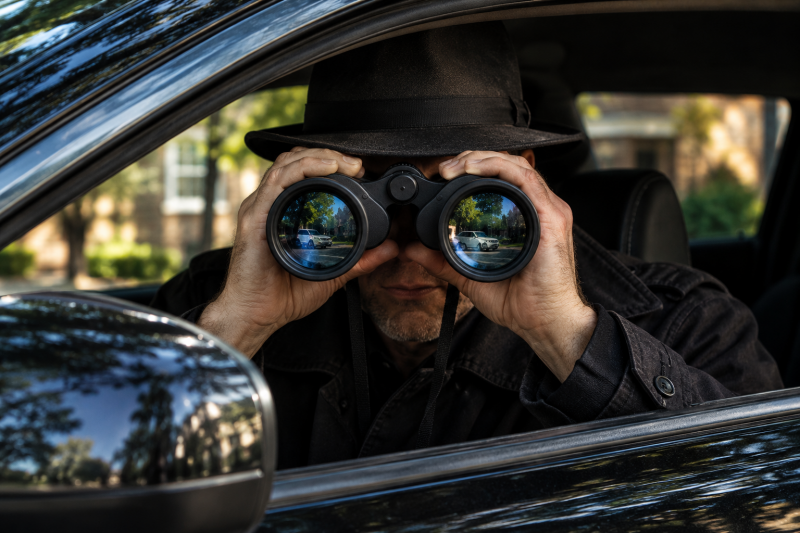
On television, a stakeout fits between two commercial breaks. A real one can take up an entire day, most of it spent watching a front door that never opens. The job depends less on clever tricks than on discipline and on knowing exactly where the public sidewalk ends.
Four Ways to Watch
Investigators usually sort surveillance into four types, and most cases use more than one.
Physical surveillance is the version everyone pictures: watching a subject in person and following on foot or by car.
Digital monitoring covers a subject’s public social media and any other online activity a stranger could see.
Interviews with coworkers, neighbors, and friends fill gaps that a camera can’t.
Technical surveillance is the photo, video, and audio record that turns an observation into evidence.
How a Surveillance Day Runs
1. The homework. The work begins at a desk. The investigator checks the subject’s vehicle registration, work schedule, and known associates, then searches public records such as court filings, property deeds, and business registrations. Many investigators also drive past the location a day or a few hours ahead to map the exits, the traffic patterns, and the best places to park.
2. The car. The ideal surveillance vehicle is one nobody remembers, such as a gray minivan or a common crossover SUV. Shades or blackout panels cover the windows, and phones and laptops are dimmed so no light shows from inside.
3. The early start. Investigators often arrive between 5:30 and 6:30 a.m. to catch a subject leaving for the day. They park along a property line or fence, or under a shade tree, but always on the public street.
4. The follow. When the subject drives off, the investigator waits until the car is a safe distance ahead before starting the engine and pulling down the shades. In heavy city traffic, he closes the gap. On an open highway, he drops back. He avoids eye contact. When two investigators work together, they trade places behind the subject so the same car never stays in the mirror too long. Traffic laws still apply, so a PI who runs a red light to keep up has broken the law and probably blown his cover.
5. The record. Every observation is captured as timestamped photos or video taken from a public vantage point. The notes are written for the day a judge reads them.
The Lines He Can’t Cross
A private investigator is a private citizen with a license. He can’t tap a phone, read someone’s texts, or break into an email account, because federal wiretap law makes intercepting communications a crime. He can’t enter private property, plant equipment on property he doesn’t own, or take someone’s mail. In Florida, he can’t put a tracking device on a vehicle he doesn’t own.
Recording rules change at the state line. Texas allows a conversation to be recorded when one participant consents, while Florida law is stricter. California places tight limits on photography in private settings. An investigator also can’t create a fake profile to get into someone’s private accounts.
Breaking these rules hurts the client too. Evidence gathered illegally can be thrown out of court, and the investigator who gathered it can face charges or a lawsuit.
What Most People Never Hear
The government can do online what a PI can’t. Under FBI guidelines, once agents open a preliminary investigation, they can use false social media identities with a supervisor’s approval. A private investigator who tries the same thing has crossed the line.
Your town may watch you more closely than any PI could. The Atlas of Surveillance, a project of the Electronic Frontier Foundation and the University of Nevada, Reno’s journalism school, catalogs the technology police use across the country, including drones, body cameras, license plate readers, and facial recognition. More than 1,000 students and volunteers built it, and you can search it by city. A private investigator has access to none of those systems.
A public post can mislead. In 2020, police in Wichita, Kansas arrested a teenager on suspicion of inciting a riot over a Snapchat post that was actually condemning violence. A good investigator treats a post as a lead and confirms it in person before trusting it.
Some surveillance is meant to be seen. Not every investigation is secret. When a case requires interviewing many people, the investigation is often run openly, and the subject knows he’s being looked at.
Elric would put it more plainly. The streetlight belongs to everybody, and the window behind it doesn’t.
References
Electronic Frontier Foundation & Reynolds School of Journalism, University of Nevada, Reno. (n.d.). Atlas of surveillance. https://www.atlasofsurveillance.org
Levinson-Waldman, R., Panduranga, H., & Patel, F. (2022, January 7). Social media surveillance by the U.S. government. Brennan Center for Justice. https://www.brennancenter.org/our-work/research-reports/social-media-surveillance-us-government
Specialized Investigations Consultants. (2026, June 16). How investigators conduct surveillance without violating privacy laws. https://sinvestigations.com/how-investigators-conduct-surveillance-without-violating-privacy-laws/
Subrosa Investigations. (2023, March 15). The 4 types of private investigator surveillance. https://subrosapi.com/blog/the-4-types-of-private-investigator-surveillance/